
|
home gallery |
| projects philosophy faq | |
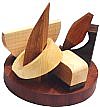 |
free plans: how to make a Block Stacking Game |
| Basic Description |
This is a fun and simple game that you can make from scraps of wood that you have leftover from other projects. As always, we offer a wide variety of options so you can customize the project and game rules to your suit your desires. It's a great game for two or more players and you can even play solitaire. It requires a unique combination of dexterity, strategy, and analysis that is enjoyed by players of all ages: its never the same game twice. |
| Materials | Wood and finishing oil. A complete material list is provided below. |
| Tools | Bandsaw or scrollsaw or jigsaw, sandpaper. A complete tool list is provided below. |
| Cost | The plan itself is free! Estimated cost of materials: $1 |
| Time | 2 hours |
| Difficulty | Easy |
| Legal Notice | Use of this website constitutes acceptance of our terms of service policy. |
| Similar Projects | If you enjoy making the small blocks required for this project, you may also be interested in our date blocks project. |

The first step involves acquiring the necessary materials and proper tools. It is best to get everything prepared before commencing because you are free to progress without unnecessary interruptions.
| Item | Qty. | Description |
| #1 | varies | small scraps of wood of any thickness; use of various species will not adversely affect gameplay. |
| #2 | - | finishing oil  |
| Tool |
| bandsaw , jigsaw or scrollsaw |
| sandpaper |
| recommended: disc sander and/or belt sander |
| recommended: drum sanding attachment for drill press
or spindle sander |
In this project, you will be making small blocks of wood in various shapes. If you choose to make only angular shapes, then you will not need any rotary sanding tools. Hand sanding will be more time-consuming but you will be able to get identical results.
Let's start with an overview of the game. It is composed of of a base which is accompanied by various blocks. The basic game proceeds as follows: one player places any block in any orientation on the base. Another player chooses a block and places it anywhere on the base or on the previously placed block. The play alternates between players and gets progressively more difficult. You lose when the block you are placing either falls or causes any other blocks to fall off the base. See the design considerations section at the end of this plan for more detailed rules and alternatives. |
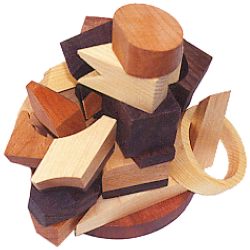 |
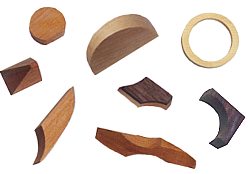
To make the block stacking game, you simply need to make a base and several blocks. We will make the blocks first and then size the base to them. To ensure that play is challenging a good rule to keep in mind is that opposite sides of the blocks should not be parallel; making a limited number of blocks that fail to meet this guideline will not adversely affect gameplay. Use a bandsaw, scrollsaw or jigsaw to cut the basic shapes and then sand curves and skewed angles with a disc and/or belt sander. We recommend that you start by making about 15 or 20 blocks; you should test their stackability on any hard and flat surface as you progress: you will get a feel for how they balance on eachother. You don't want them to be too easy to stack, so making oddly shaped blocks is beneficial. Our set included blocks that were 3/4" x 1" x 1 1/4" (20 x 25 x 30mm) and 3/4" x 3/4" x 3 1/4" (20 x 20 x 80mm) and 1/2" x 1 1/2" x 2 1/2" (15 x 40 x 65mm). One of the great things about this project, is that it can be made out of scraps that you already have. We used cherry from the wine rack and magazine holder; maple from the shallow box, walnut from the impossible stack sculpture; mahogany from a mallet; and some leftover pine and makore. Playing the game reminds you of the other projects that you completed and this adds a unique dimension to the experience. Using different woods provides different densities and makes gameplay interesting, although this project can also be made out of one species of wood. |
 |
With most of the blocks already complete, you are ready to make the base. Start by oversizing the base and playing a test game, if it is very easy to stack all the blocks, then the base is too big. We made a round base with a 3 3/4" (95mm) diameter, but the shape is not critical - it doesn't even have to be flat. Bring the size down in small increments until stacking all the blocks becomes challenging or make more blocks to accommodate the size of the base. We recommend that you make a few more blocks to ensure that it is virtually impossible to balance all the blocks on the base. This will make for a challenging solitaire game. A few extra blocks is also a good way to keep the game functional even if you lose a block or two. The shapes are not critical, but we recommend that the base be relatively flat and the blocks are of similar size. The only critical component is the ratio of the base size to the size and number of the blocks. If the base is too big, then the game will not be challenging, if it is too small then you will only be able to fit a few blocks on it. |
Once you have a sufficient number of blocks (we made 27) and you have played several games and are certain that the complexity level is suitable, you are ready to proceed. Sand all the pieces using progressively finer grits of sandpaper (we used the grits in the following order: 100, 120, 150, 180, 240, 320, 400) and it's probably a good idea to sand off the sharp corners to prevent injury.
Once all of the pieces sanded, they are ready for a finish. You can use a stain and follow with a polyurethane. We used three coats of antique oil which is an oil/ varnish blend consisting of mineral spirits, oil, and a spar varnish. For more detailed information regarding finishing, consider Understanding Wood Finishing by Bob Flexner. Let the pieces completely dry before playing.
Simply try to balance all the blocks on the base. If this is too easy, then you can either make the base smaller, make more blocks, make the shapes of the blocks more complicated, or put one or more of the blocks beneath the base rendering it slightly unstable. These variations provide an unlimited number of options. You can also time yourself and try to beat your record. How to Play a Multiplayer GameAny number of players can play: simply choose who is going first and alternate turns. It doesn't really matter who starts because the first several pieces cannot fall because they are placed directly on the base. A player places any block in any orientation on the base. Another player chooses a block and places it anywhere on the base or on a previously placed block. You cannot touch placed blocks with your hands and you cannot move blocks with the block that you are placing. If a block settles due to the weight of your block, that is fine, but you may not intentionally move existing blocks. The play alternates between players and gets progressively more difficult. You lose when the block you are placing falls or causes any other block(s) to fall off the base. |
|
Alternative RulesThere are many alternative rules that provide a new flavor to the game. You can incorporate or replace any or all of the following rules in to the basic instructions: |
MaterialsYou can use any material but we chose wood because it is easy to work with, looks good and we had lots of scrap laying around. We made the game out of several different species of wood to add some complexity. SizeThe size of the blocks and the base are not critical for gameplay, but they do need to be properly sized to each other. If the pieces are very small, it will be difficult to place them but this would add a unique twist to gameplay: we envision a game played with tweezers. Remember that small pieces can be dangerous for young children. If you opt to make rather large blocks, you should refrain from placing blocks in a place where they can fall down on anyone or anything of importance. |
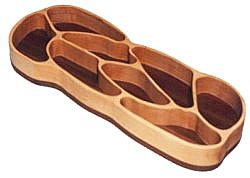
Number of BlocksWe made 27 blocks, but the number you need will be determined by several factors. You should make as many blocks as necessary to make it very difficult to place all the blocks in a game of solitaire. If it takes too many blocks to reach this critical point, then the gameplay will be very long and drawn out; the final stages of matches will be exciting, but the beginnings will tend to be less interesting. StorageThe blocks call out for a wooden box to store them in. Any box will do, but a particularly appealing solution is to make a customized shallow box for the pieces. You should complete this project first before beginning any box you choose to make so that you are sure of the dimensional requirements. |
 |
|
© 2000-2008
terms privacy policy |
home gallery |
| projects philosophy faq | ||
